
Reducing Credit Card Chargebacks: A Small Business Guide
August 17, 2026 · 17 min read
Every time a customer disputes a valid transaction, your business isn't just losing a sale; it's being penalized for doing its job. This double loss of both inventory and revenue is one of the most frustrating aspects of running a local shop. You've likely felt the sting of "friendly fraud," where a legitimate purchase is contested, leaving you with high processor fees and zero recourse. It's a complex problem that often feels weighted against the merchant, but it doesn't have to stay that way.
We're here to act as your advocate by showing you exactly how to reduce credit card chargebacks through better technology and clearer operations. This guide provides a proven strategy for 2026 to help you slash dispute rates and protect your hard-earned income. We'll preview how Clover and Valor Paytech hardware can provide the digital proof you need to win disputes, while also exploring how PCI compliance and Cash Discount Programs build a more transparent checkout experience. You'll walk away with a clear plan to stop the revenue leak and focus on growing your business with confidence.
Key Takeaways
- Identify the hidden costs of disputes beyond the transaction amount to better protect your 2026 profit margins.
- Explore how Clover and Valor Paytech hardware use EMV technology and digital signatures to provide an indisputable paper trail for every transaction.
- Implement five immediate operational changes, including refining your billing descriptors, to learn how to reduce credit card chargebacks effectively.
- Leverage local support and transparent processing programs to resolve conflicts quickly and eliminate the customer confusion that leads to "friendly fraud."
Understanding the Real Cost of Credit Card Chargebacks in 2026
A chargeback occurs when a cardholder asks their bank to forcibly reverse a transaction. Unlike a standard refund where you control the funds, this process bypasses the merchant entirely. To better understand the technical origins of these disputes, you can research what is a chargeback and how the mechanism was originally designed to protect consumers from unauthorized billing. In 2026, understanding this process is the first step in learning how to reduce credit card chargebacks and protect your bottom line.
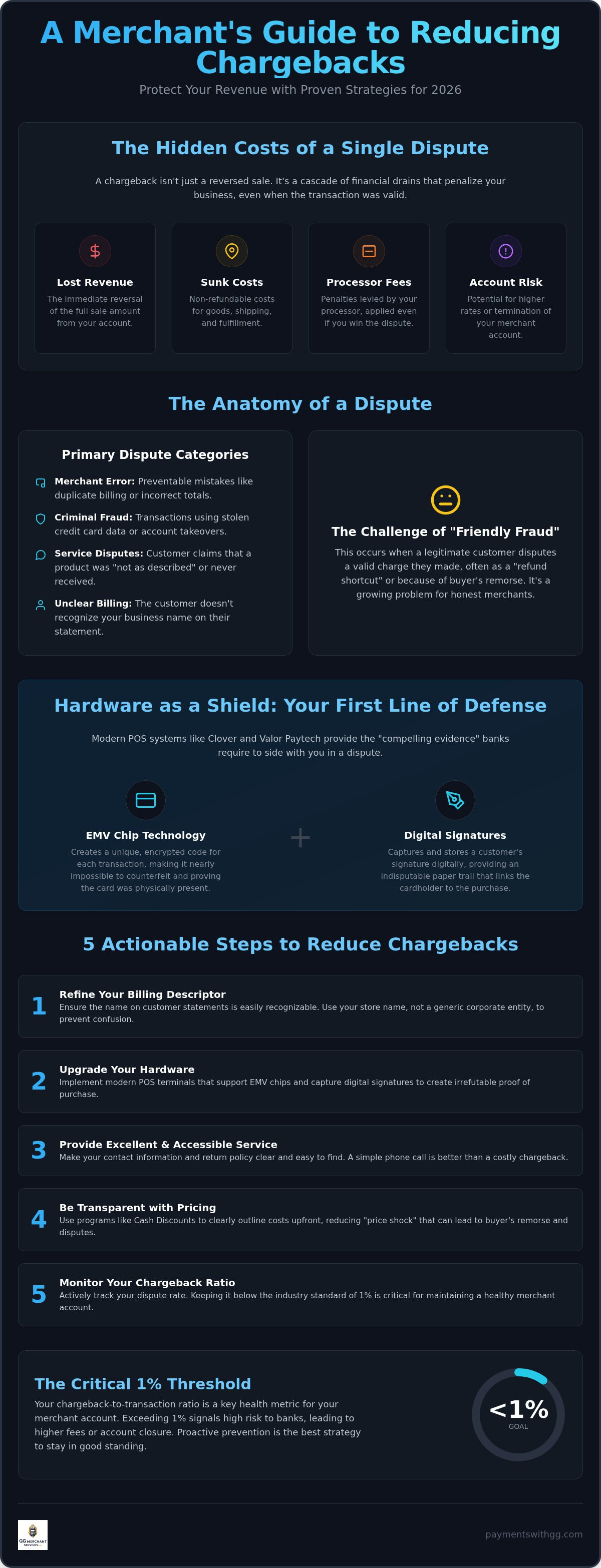
The costs are rarely limited to the transaction amount. When a dispute is filed, your business faces a cascade of financial drains:
- Lost Revenue: The immediate reversal of the sale amount from your bank account.
- Sunk Costs: Non-refundable shipping, fulfillment, and cost of goods sold.
- Processor Fees: Fees levied by your processor for handling the dispute, which apply even if you win.
- Account Risk: Potential increases in your overall processing rates or termination of your merchant account.
Distinguishing between "True Fraud" and "Friendly Fraud" is essential for your defense. True fraud involves stolen credit card data used by criminals. Friendly fraud, however, happens when a legitimate customer disputes a charge they actually made. This might occur because they didn't recognize your business name on their statement or are attempting to get a free product. Maintaining a chargeback-to-transaction ratio below 1% is the critical threshold for 2026 standards to keep your merchant account in good standing.
The Financial Impact on Sacramento Small Businesses
Local retailers in Roseville and Folsom often face unique challenges when disputes arise. For a small boutique or a family-owned cafe, the cumulative effect of these fees can erode monthly margins quickly. High dispute volumes signal to banks that your business is a liability, which can lead to higher reserve requirements. The chargeback-to-transaction ratio for 2026 standards is calculated by dividing the number of monthly chargebacks by the total number of successful transactions.
Why Banks Usually Side with the Consumer
The Fair Credit Billing Act established a framework that heavily favors the cardholder. Banks are legally incentivized to protect their customers, which often places the burden of proof entirely on you. If you lack "compelling evidence," such as a verified digital signature or a clear customer history from your Clover POS, the bank will default the win to the consumer. This is why capturing every detail at the point of sale is your best defense. Learning how to reduce credit card chargebacks starts with having the right hardware to prove a transaction was valid from the start.
The Anatomy of a Dispute: Why Chargebacks Happen
Understanding why disputes occur is the first step toward prevention. While some issues are out of your control, many stem from simple operational gaps that can be closed with better oversight. By pinpointing these specific triggers, you can master how to reduce credit card chargebacks and protect your revenue from unnecessary reversals.
Disputes generally fall into four primary categories:
- Merchant Error: These are preventable mistakes like duplicate billing, incorrect totals, or failing to process a cancellation in a timely manner.
- Criminal Fraud: This involves stolen card data or account takeover attacks where the actual cardholder is a victim of identity theft.
- Service Disputes: These occur when a customer claims the product was "not as described" or was never received.
- Unclear Billing Descriptors: This happens when a customer doesn't recognize your business name on their bank statement and assumes the charge is unauthorized.
Friendly Fraud: The Growing Challenge for Merchants
Friendly fraud is particularly frustrating because the transaction itself was legitimate. Customers often use a chargeback as a "refund shortcut" because it's faster than calling the store or following a return policy. You can often identify patterns in habitual fraudsters, such as those who frequently claim non-receipt despite delivery confirmation. Implementing a transparent Cash Discount Program can also help by clearly outlining costs upfront. This reduces the "price shock" that often leads a customer to regret a purchase and initiate a dispute through their bank.
Technical Failures and Processing Errors
Legacy hardware is often a hidden culprit in chargeback cases. Outdated terminals can lead to double-processing errors or failed batches that confuse both the bank and the customer. Manual entry, or "keyed-in" transactions, carries much higher risk than EMV chip dips because they lack the same level of encryption and verification. If a dispute arises from a keyed-in sale, the merchant almost always loses by default.
Accurate batching is also vital for next-day funding. If your batch totals don't match your daily records, reconciliation becomes a nightmare. This often results in accidental double-billing that triggers a customer dispute. Using modern Clover POS systems or Valor Paytech terminals ensures that every transaction is logged correctly and batched on time. This technical reliability is a cornerstone of a healthy merchant account and a practical way to learn how to reduce credit card chargebacks through better hardware.
Hardware as a Shield: Using Clover and Valor Paytech for Fraud Prevention
Modern payment terminals are more than just tools for processing transactions; they are your first line of defense against revenue loss. While operational policies are important, the physical hardware you use determines who is responsible when a dispute arises. Investing in the right technology is one of the most effective ways to learn how to reduce credit card chargebacks by automating the collection of indisputable evidence at the point of sale.
The transition to EMV chip technology fundamentally changed the landscape of merchant liability. When you process a transaction using a chip dip rather than a magnetic stripe swipe, the liability for counterfeit fraud shifts from your business to the card-issuing bank. If you are still swiping cards or manually keying in numbers, you're voluntarily accepting 100% of the risk. High-volume retail environments benefit significantly from advanced payment terminals, which provide secure, end-to-end encryption to ensure that sensitive data is protected from the moment a card touches the device.
Advanced POS Systems: More Than Just a Register
Our integrated POS systems provide a comprehensive digital trail that makes it difficult for customers to claim they didn't authorize a purchase. By capturing digital signatures directly on the screen, you create a permanent record that is much more reliable than a faded thermal paper slip. You can also use their customer profiles to track purchase history. If a regular customer suddenly disputes a charge, you have the data to prove their identity and previous shopping patterns.
Automated digital receipt delivery is another powerful feature. When a customer receives an immediate email or SMS receipt, the transaction is fresh in their mind. This prevents the "I don't recognize this" factor that leads to many friendly fraud disputes. These systems' app ecosystems also allow you to integrate advanced fraud screening tools that flag suspicious patterns before the sale is even finalized.
Valor Paytech: Advanced Security for Mobile Merchants
For field service businesses operating in Davis or Woodland, mobile security is a top priority. Valor Paytech terminals are designed for these environments, offering mobile EMV capabilities that protect you while you're on the go. These devices include built-in risk management tools specifically for card-not-present (CNP) environments, such as Address Verification Service (AVS) and CVV checks. These layers of security verify that the person providing the card info actually possesses the physical card and lives at the associated billing address.
Using Valor's SMS receipting feature provides immediate transaction validation. This is a practical step in learning how to reduce credit card chargebacks because it gives the customer an instant record they can refer back to. When your hardware works this hard to verify every sale, you can spend less time worrying about disputes and more time serving your local community.
5 Actionable Steps to Reduce Chargebacks Immediately
While hardware provides the technical foundation, your daily operations determine your ultimate success in keeping revenue. You can take immediate control of your dispute ratio by refining how you interact with customers and how you present your business on their bank statements. These five steps are the most effective ways to master how to reduce credit card chargebacks without needing a massive budget.
- Optimize your billing descriptor: Ensure your statement name includes your actual business name and city so customers recognize the charge. A sample descriptor like GG-Merch-Sac-916-555-0199 tells the customer exactly who you are and how to call you directly.
- Implement a clear return policy: Display a 30-day return policy prominently at your checkout counter and on every receipt. When customers know they have a path to a refund, they're less likely to call their bank.
- Train your local teams: Staff at your Elk Grove and Sacramento locations should be trained on proper card-handling, such as never forcing a transaction if a chip reader fails.
- Use Cash Discount signage: Explain processing fees upfront with clear signage. This transparency prevents the "price shock" that often leads to a disputed transaction.
- Respond to retrieval requests: Treat these as an early warning system. A retrieval request is a bank's way of asking for more info before a full chargeback is filed; responding immediately can stop the dispute in its tracks.
Optimizing Your Customer Communication
A proactive approach to customer service can save thousands in lost revenue. If you see a suspicious or unusually large order, like a $500 purchase from a new customer, a quick phone call to verify the details can prevent a fraudulent shipment. You should also set up automated notifications that send "Order Shipped" and "Order Delivered" alerts with tracking links. These touchpoints keep the customer informed and reduce the likelihood of "Item Not Received" claims. To ensure your business is protected by these best practices, you can explore our transparent merchant services for a more secure setup.
The Role of PCI Compliance in Dispute Defense
PCI compliance isn't just a regulatory hurdle; it's a vital part of your legal defense. When you're fully compliant, you prove to the banks that you follow industry-standard security protocols, which protects your right to fight a dispute. Storing card data improperly, such as on paper slips or in unprotected digital files, is a guaranteed way to lose a chargeback case. You should leverage your processor's built-in security suite to automate compliance tasks and ensure your data handling is always up to date. This disciplined approach to security is a cornerstone of learning how to reduce credit card chargebacks while building long-term trust with your local clientele.
Partnering for Protection: GG Merchant Services’ Approach
GG Merchant Services LLC approaches payment processing with a focus on advocacy rather than just transaction volume. We understand that for a small business, a single chargeback can represent a significant percentage of your daily profit. By providing the tools and local expertise necessary to master how to reduce credit card chargebacks, we help you build a more resilient financial foundation. Our team acts as a straightforward guide, helping you navigate the complexities of merchant services without the hidden complications often found in national contracts.
Our Cash Discount Program is a key part of this protective strategy. By clearly explaining processing costs at the point of sale, you eliminate the "price shock" that can lead to customer frustration and subsequent disputes. This transparency builds trust and ensures that your customers feel confident in their purchase. Additionally, our next-day funding for qualifying businesses ensures that your cash flow remains steady, even if you are currently managing a pending dispute. We also offer secure Clover and Valor Paytech terminals, often with free hardware options, so you can upgrade to the latest EMV security without an upfront financial burden.
Why Central California Merchants Trust GG Merchant Services LLC
Merchants in Folsom and Roseville value our "straight shooter" consulting style because it prioritizes their long-term success over immediate sales. When a dispute hits, having a Sacramento-based partner means you aren't stuck in a phone queue with a representative who doesn't understand your business. We help local owners navigate the representment process by identifying the specific evidence needed to win. A personalized merchant account review allows us to look at your unique fraud risk and suggest targeted hardware or operational changes. This hands-on, localized support is exactly what sets GG Merchant Services LLC apart from enterprise-level processors.
Get Started with Secure Processing Today
Switching to a more secure processing system doesn't have to interrupt your daily operations. Our team handles the transition with digital efficiency, ensuring your new Clover or Valor terminals are ready to go the moment you need them. We invite you to contact us for a free audit of your current chargeback rates and processing fees. This no-pressure review is designed to show you exactly how to reduce credit card chargebacks and where you can save on unnecessary costs. It's time to stop losing money to preventable disputes and start working with a partner who values your growth. You can protect your revenue with a secure merchant account from GG Merchant Services LLC and gain the peace of mind that comes with professional local support.
Securing Your Revenue and Growing with Confidence
Protecting your business from the financial drain of disputes is about more than just security; it's about building a foundation of trust and transparency with every customer. You have seen how modern EMV hardware and clear operational policies shift the burden of proof back to the banks where it belongs. By refining your billing descriptors and capturing digital signatures, you create an indisputable record that keeps your chargeback ratio healthy. Mastering how to reduce credit card chargebacks is an ongoing process of improvement that pays dividends in long-term stability.
As an authorized Clover and Valor Paytech provider, we provide the localized support and technical expertise you need to stay ahead of fraud. We offer next-day funding to keep your cash flow moving even when challenges arise. It's time to stop letting preventable disputes erode your hard-earned margins. Request a free merchant services audit for your Sacramento business today and let us help you streamline your processing. You have built something valuable; we're here to help you protect it.
Frequently Asked Questions
What is a chargeback fee and can I get it refunded?
A chargeback fee is a non-refundable administrative cost charged by your processor to cover the labor involved in a bank investigation. Even if you win the dispute, the fee typically remains because the bank has already performed the work of reviewing the case. This is why prevention is vital. Working with a supportive partner helps you understand these fees upfront so they don't surprise you when a dispute occurs.
How long does a customer have to dispute a credit card charge in 2026?
Most card networks allow customers up to 120 days from the transaction date to initiate a dispute. However, specific cases like service delivery issues can extend this window to 540 days in certain jurisdictions. It's essential to keep accurate digital records for at least six months. This ensures you have the evidence required to fight older claims if they arise unexpectedly from a customer who forgot a purchase.
Can a Cash Discount Program actually help reduce my chargeback rate?
Yes, a Cash Discount Program reduces disputes by increasing price transparency at the point of sale. When customers see exactly how much they are paying and why, it eliminates the "hidden fee" confusion that often triggers friendly fraud. This clear communication is a practical strategy for merchants learning how to reduce credit card chargebacks by setting accurate expectations before the customer leaves the store with their goods.
What is the difference between a retrieval request and a chargeback?
A retrieval request is an inquiry from the cardholder's bank asking for more information, whereas a chargeback is the actual reversal of funds. Think of a retrieval as a warning shot. Responding to these requests with proof of purchase or a signed receipt can often resolve the customer's confusion. This proactive step prevents the situation from escalating into a full, costly chargeback that impacts your revenue.
Does Clover POS have built-in fraud protection for small businesses?
Clover POS systems include several layers of security, such as end-to-end encryption and built-in EMV chip technology. These features protect you by shifting liability to the bank for counterfeit card use. Additionally, Clover's software allows you to capture customer signatures and digital receipts. This provides a reliable paper trail that is essential for winning disputes and maintaining a secure merchant account for your local shop.
How do I win a chargeback dispute if I have a signed receipt?
Winning a dispute requires submitting the signed receipt as part of your "compelling evidence" during the representment process. You must show the bank that the signature matches the cardholder's name and that the transaction was authorized in person. Having high-quality digital signatures captured on modern terminals makes this evidence much harder for a bank or a cardholder to dispute successfully when they review your claim.
What happens if my chargeback ratio goes above 1%?
Exceeding a 1% chargeback-to-transaction ratio places your business in a high-risk category. Banks may place your merchant account on a monitoring program, increase your processing fees, or even terminate your ability to accept cards. Learning how to reduce credit card chargebacks through better hardware and training is the only way to move back into good standing. Staying under this threshold is vital for your long-term financial health.
Is it better to refund a customer than to risk a chargeback?
It is almost always better to issue a refund if you suspect a dispute is coming. Refunds cost you only the transaction amount, while chargebacks include the lost revenue, the cost of goods, and a non-refundable dispute fee. Proactively managing customer complaints and offering a straightforward refund policy can prevent a frustrated customer from calling their bank. This preserves your reputation with the processor and avoids unnecessary penalties.
Frequently Asked Questions
A chargeback fee is a non-refundable administrative cost charged by your processor to cover the labor involved in a bank investigation. Even if you win the dispute, the fee typically remains because the bank has already performed the work of reviewing the case. This is why prevention is vital. Working with a supportive partner helps you understand these fees upfront so they don't surprise you when a dispute occurs.
Most card networks allow customers up to 120 days from the transaction date to initiate a dispute. However, specific cases like service delivery issues can extend this window to 540 days in certain jurisdictions. It's essential to keep accurate digital records for at least six months. This ensures you have the evidence required to fight older claims if they arise unexpectedly from a customer who forgot a purchase.
Yes, a Cash Discount Program reduces disputes by increasing price transparency at the point of sale. When customers see exactly how much they are paying and why, it eliminates the "hidden fee" confusion that often triggers friendly fraud. This clear communication is a practical strategy for merchants learning how to reduce credit card chargebacks by setting accurate expectations before the customer leaves the store with their goods.
A retrieval request is an inquiry from the cardholder's bank asking for more information, whereas a chargeback is the actual reversal of funds. Think of a retrieval as a warning shot. Responding to these requests with proof of purchase or a signed receipt can often resolve the customer's confusion. This proactive step prevents the situation from escalating into a full, costly chargeback that impacts your revenue.
Clover POS systems include several layers of security, such as end-to-end encryption and built-in EMV chip technology. These features protect you by shifting liability to the bank for counterfeit card use. Additionally, Clover's software allows you to capture customer signatures and digital receipts. This provides a reliable paper trail that is essential for winning disputes and maintaining a secure merchant account for your local shop.
Winning a dispute requires submitting the signed receipt as part of your "compelling evidence" during the representment process. You must show the bank that the signature matches the cardholder's name and that the transaction was authorized in person. Having high-quality digital signatures captured on modern terminals makes this evidence much harder for a bank or a cardholder to dispute successfully when they review your claim.
Exceeding a 1% chargeback-to-transaction ratio places your business in a high-risk category. Banks may place your merchant account on a monitoring program, increase your processing fees, or even terminate your ability to accept cards. Learning how to reduce credit card chargebacks through better hardware and training is the only way to move back into good standing. Staying under this threshold is vital for your long-term financial health.
It is almost always better to issue a refund if you suspect a dispute is coming. Refunds cost you only the transaction amount, while chargebacks include the lost revenue, the cost of goods, and a non-refundable dispute fee. Proactively managing customer complaints and offering a straightforward refund policy can prevent a frustrated customer from calling their bank. This preserves your reputation with the processor and avoids unnecessary penalties.