
Passing Processing Fees to Customers Legally in 2026
August 16, 2026 · 17 min read
What if the 3% you lose on every credit card transaction wasn't an inevitable cost of doing business, but a choice you no longer had to make? It's a question many local shop owners ask as they watch their overhead climb. You likely feel the pressure of shrinking margins, yet you worry that trying to pass processing fees to customers legally might drive them toward your competitors or land you in a compliance nightmare. It's a valid concern, especially when state laws and card brand rules often feel like a moving target.
We believe you deserve to keep more of your hard-earned revenue without sacrificing the trust you've built in your community. You can eliminate your processing overhead and maintain 100% legal compliance by shifting from a "fee" mindset to a "discount" strategy. This guide demystifies the 2026 legal frameworks, including specific restrictions in states like Connecticut and Massachusetts. You'll learn exactly how to implement a Cash Discount Program, supported by the cutting-edge hardware and software solutions that GG Merchant Services LLC provides to handle the technical heavy lifting for you. This ensures your pricing stays transparent, your customers stay happy, and your business stays profitable.
Key Takeaways
- Understand the federal landscape and state-specific restrictions to ensure your business remains fully compliant with 2026 regulations.
- Discover how to pass processing fees to customers legally by utilizing a Cash Discount Program, which is often a more flexible alternative to traditional surcharging.
- Learn why applying surcharges to debit card transactions is a major compliance risk and how to avoid the "debit card trap" under the Durbin Amendment.
- Master the specific signage and receipt requirements needed to maintain transparency and protect your business during card brand audits.
- See how automated POS systems like Clover and Valor Paytech can handle complex dual-pricing calculations for you, eliminating manual errors and technical stress.
Is Passing Credit Card Fees to Customers Legal in 2026?
The short answer is yes. It's entirely possible to pass processing fees to customers legally at the federal level. This reality is the result of years of litigation and landmark settlements between merchants and major card brands. While the landscape used to be a patchwork of confusion, 2026 standards have brought much-needed clarity to how businesses can protect their margins. Legality isn't a blanket permission slip, though. It's a framework that requires strict adherence to specific rules to ensure fairness for the consumer.
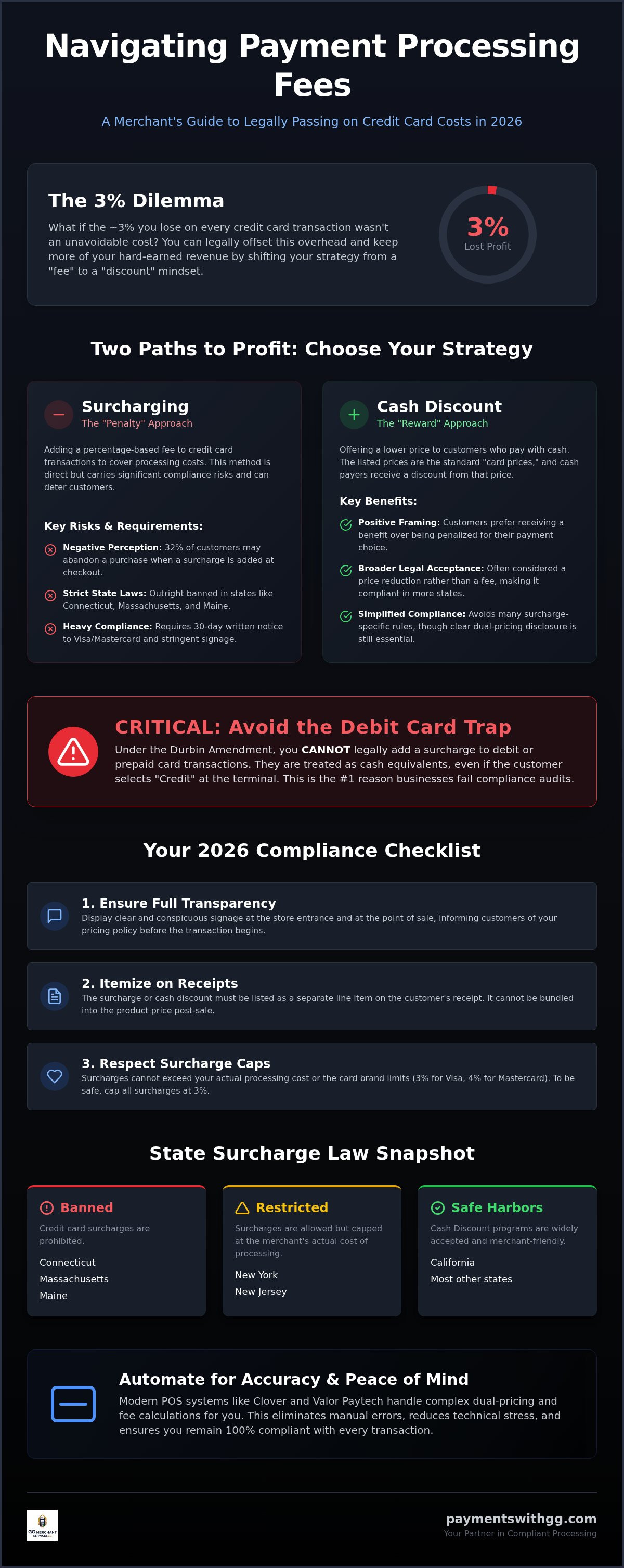
The core of this framework rests on the distinction between credit and debit transactions. Under the Durbin Amendment, debit cards are treated differently because they're considered a cash equivalent. You cannot legally add a payment surcharge to a debit card transaction, regardless of whether the customer chooses "credit" or "debit" at the terminal. Failing to recognize this distinction is the most common reason businesses face audits or fines. Additionally, card brands enforce their own caps. As of August 2026, Visa limits surcharges to 3%, while Mastercard allows up to 4%. If you accept both, you must stick to the lower 3% limit to stay compliant.
It's also important to distinguish between various fee types. A "Convenience Fee" is typically a flat charge for a non-standard payment channel, like paying a utility bill online. A "Surcharge" is a percentage added specifically to credit card transactions. A "Cash Discount" is a reduction in the standard price for those who pay with cash. Each has its own set of regulations, and mixing them up can lead to technical non-compliance.
The Legal Evolution: From Bans to Transparency
The journey to today's transparency started with merchants challenging state-level bans on First Amendment grounds. Courts increasingly ruled that these bans unconstitutionally restricted how businesses communicated their pricing. By 2026, the focus has shifted from whether you can offset fees to how clearly you communicate those costs. Transparency is now the legal gold standard. This means you can't surprise a customer at the end of a transaction. The law requires that any fee or discount is disclosed before the sale begins, ensuring the customer can make an informed choice about their payment method.
Federal vs. State Regulations
While federal rulings provide the baseline, state laws dictate the specific operational requirements. Most states are considered "Safe Harbors" where these programs are widely accepted. California, for instance, has a merchant-friendly environment for Cash Discount Programs, allowing local businesses to thrive by offering dual pricing. However, a few exceptions remain. As of August 2026, Connecticut, Massachusetts, and Maine still maintain outright bans on credit card surcharges. In states like New York and New Jersey, surcharges are allowed but are strictly capped at the merchant's actual cost of processing. Understanding these regional nuances is vital for staying on the right side of the law.
Choosing the right method to pass processing fees to customers legally often comes down to a choice between a "penalty" and a "reward." While both strategies aim to protect your bottom line, they exist in very different regulatory and psychological spaces. Surcharging is the practice of adding an extra fee to a credit card transaction at the point of sale. It's a direct way to recover costs, but it carries a heavy burden of compliance. Because State surcharge laws vary significantly, many merchants find themselves on shaky ground if they don't follow every card brand rule to the letter.
Cash discounting takes the opposite approach. Instead of adding a fee for credit, you offer a lower price to those who pay with cash. In this model, your listed prices are effectively the "card prices." This subtle shift in framing is often considered a legal "loophole" because it qualifies as a price reduction rather than a fee addition. From a consumer perspective, this is a game-changer. Research from J.D. Power in 2026 indicates that 32% of customers have occasionally or frequently abandoned a purchase when a surcharge was added at checkout. People naturally prefer receiving a benefit over being penalized for their payment choice.
The Compliance Risks of Surcharging
If you choose to surcharge, you must be prepared for rigorous oversight. First, you're required to provide a 30-day written notification to Visa and Mastercard before you start. You also face a strict federal prohibition on surcharging debit or prepaid cards. This is a common trap; even if a customer runs a debit card as "credit," adding a surcharge is still a violation of card network rules. Your receipts must also show the surcharge as a separate, clearly labeled line item. If these technical details feel overwhelming, looking into a managed Cash Discount Program can provide a much simpler path to compliance.
The Advantages of the Cash Discount Model
Cash discounting is becoming the 2026 standard for retail and dining because it offers universal legality across all 50 states when implemented correctly. It bypasses the complex restrictions placed on surcharges because it's fundamentally a discount, not a fee. This significantly lowers your risk of card brand audits or fines. Many modern businesses are now adopting "Dual Pricing," where both the cash and card prices are displayed clearly on every item or on the terminal. This level of transparency builds trust and ensures you're never caught in a legal gray area while protecting your margins.
Compliance Checklist: The Rules for Legally Offsetting Fees
Compliance is the bridge between saving money and staying in business. To pass processing fees to customers legally, you need a repeatable system that satisfies both state regulators and card brand auditors. While the federal landscape has opened doors for merchants, the burden of proof remains on you to show that your program is transparent and non-discriminatory. Following a strict checklist ensures you don't just offset costs, but you do so in a way that protects your merchant account from unexpected freezes or fines.
One of the first steps in a compliant surcharging program is official notification. You must inform Visa and Mastercard at least 30 days before you begin adding fees to transactions. This isn't just a courtesy; it's a requirement of your merchant agreement. Additionally, you have to stay within the card brands’ maximum fee caps. As of 2026, you cannot charge more than your actual cost of acceptance, which is capped at 3% for Visa and 4% for Mastercard. If you accept both, the lower 3% cap becomes your ceiling. Because state-by-state credit card surcharge laws can add another layer of complexity, staying strictly within these cost-recovery limits is your best defense against legal challenges.
Required Signage and Disclosures
Transparency starts before the customer even reaches for their wallet. You're required to post clear signage at your business entrance and at every point of sale. These signs shouldn't be hidden behind a counter or printed in microscopic text. They must explicitly state that a fee applies to credit card purchases. In local communities like Roseville and Elk Grove, we see many successful merchants using bold, simple language that explains the "why" behind the program. This proactive approach eliminates the friction of a surprise charge and keeps you compliant with California's consumer protection standards.
Receipt and Accounting Standards
Your point-of-sale system must be capable of handling the math automatically. Every receipt must show the "Non-Cash Adjustment" or surcharge as a separate, clearly labeled line item. This isn't just for the customer's benefit; it's essential for your own accounting and for handling returns. If a customer returns an item, you must also refund the proportional fee they paid. Clear and conspicuous disclosure in the context of merchant receipts means the adjustment is listed separately from the subtotal in a font size and style that is easily readable by the average consumer. Using modern hardware like Clover or Valor Paytech terminals ensures these calculations happen instantly, keeping your books clean and your business safe.
Avoiding the Debit Card Trap: Why Most "Surcharges" Fail Compliance
Many merchants believe they can pass processing fees to customers legally simply by adding a percentage to the total at checkout. This is a dangerous assumption that often leads to the "debit card trap." While surcharging credit cards is permitted under specific frameworks, federal law creates a hard line that you cannot cross. The Durbin Amendment, implemented as Regulation II, strictly prohibits surcharging debit card transactions. This rule applies regardless of how the customer chooses to process the payment at the terminal.
The most common compliance failure happens when a customer uses a debit card but selects "credit" to avoid entering a PIN. To the merchant, it looks like a credit transaction. To the card brands and federal regulators, it remains a debit transaction. If your system adds a surcharge to this sale, you're in violation of both card network rules and federal law. A Cash Discount Program bypasses this trap entirely. Because it offers a lower price for cash rather than adding a fee to a card, it doesn't discriminate between card types, making it a much safer path for long-term stability.
Debit vs. Credit: The Technical Difference
Staying compliant requires hardware that is smarter than the average credit card terminal. Older systems often fail to distinguish between "signature debit" and actual credit cards, which leads to accidental illegal surcharges. Modern solutions like Dejavoo POS and Valor Paytech Terminals use real-time Bank Identification Number (BIN) lookups. They identify the card type the moment it's swiped or tapped. If a debit card is detected, these systems automatically suppress the surcharge. This automation removes the risk of human error and ensures your staff doesn't have to play "compliance officer" during a busy shift.
Protecting Your Merchant Account
The consequences of a compliance slip-up are more than just a slap on the wrist. Card brands like Visa and Mastercard employ "Secret Shoppers" to monitor merchant behavior. If you're caught surcharging debit cards, you face heavy fines and the potential termination of your merchant account. Illegal surcharges also significantly increase your chargeback risk. Customers who spot an unauthorized fee on their statement are much more likely to dispute the entire transaction. We encourage Sacramento business owners to audit their current fee structure annually to ensure their hardware and signage meet current 2026 standards. If you aren't sure if your current setup is protected, you can get a free compliance review here to secure your business.
Implementing a Compliant Cash Discount Program with GG Merchant Services LLC
Managing the technical side of a Cash Discount Program shouldn't be your second job. While the legalities we've discussed are complex, the right partnership turns these requirements into a "set it and forget it" reality. GG Merchant Services LLC specializes in helping you pass processing fees to customers legally by automating the entire process through intelligent hardware and localized support. We don't just provide a terminal; we provide a protective layer between your business and the shifting rules of card brands.
Our approach pairs fee-free processing with Next Day Funding, ensuring your cash flow remains as fast as your service. For businesses in the Sacramento area, from Woodland to Davis, having a local partner means you aren't stuck waiting on a faceless 1-800 number when you have a question. We're invested in your success because we're part of the same community. This local connection allows us to provide hands-on assistance that enterprise-level processors simply cannot match.
Smart Hardware: Clover, Valor, and Dejavoo
The hardware you use is the first line of defense in maintaining transparency. Valor Paytech Terminals are specifically designed with built-in cash discount prompts that guide both your staff and your customers through the transaction. If you prefer a more robust ecosystem, Clover POS Systems can be customized to display dual-pricing clearly, showing the card price and the cash price side-by-side to eliminate any confusion. For high-volume local retail, Dejavoo POS remains a reliable choice, offering the speed and card-type detection necessary to avoid the debit card traps mentioned earlier. These systems handle the math automatically, so your employees don't have to calculate discounts manually.
Getting Started: The GG Merchant Services LLC Process
Transitioning to a compliant program starts with a thorough audit of your current processing statement. We look for hidden fees and identify exactly how much revenue you're losing to overhead. Once we've identified the right hardware for your needs, we handle the setup and provide hands-on training for your team. It's vital that your staff knows how to explain the program with confidence and clarity. As your advocate, GG Merchant Services LLC also monitors card brand rule changes to ensure your business stays 100% compliant year after year. We take the guesswork out of financial regulations so you can focus on running your business.
Ready to reclaim your profit margins? Get a free compliance audit for your Sacramento business today and see how easy it is to modernize your checkout process.
Secure Your Profits with Compliant Processing
Protecting your bottom line shouldn't feel like a legal gamble. By shifting toward a transparent Cash Discount Program, you can pass processing fees to customers legally while actually improving your relationship with your community. We've explored how hardware from Clover or Valor Paytech removes the burden of manual calculations and prevents the common "debit card trap" that causes so many compliance headaches. Clarity and automation are your best tools for maintaining stability in 2026.
You don't have to navigate these complex industry shifts alone. As a Sacramento-based partner, GG Merchant Services LLC provides the localized support and Next Day Funding you need to keep your business moving forward with confidence. It's time to stop letting overhead eat into your revenue and start using a system designed for your specific needs. We're here to help you build a more profitable future for your local business.
Eliminate your processing fees legally-Contact GG Merchant Services LLC
Frequently Asked Questions
Is it legal to pass credit card fees to customers in California?
Yes, it is legal to pass these costs to your customers in California. While the state once restricted these practices, court rulings have established that merchants have a First Amendment right to communicate the costs of credit acceptance. Most local businesses in the Sacramento area find that a Cash Discount Program is the most straightforward way to implement this while staying fully compliant with the state's consumer protection standards.
What is the maximum percentage I can charge as a surcharge?
The maximum percentage depends on the card networks you accept. As of 2026, Visa limits surcharges to 3% of the transaction amount, while Mastercard allows up to 4%. If you accept both card brands, you must adhere to the lower 3% cap for all transactions to remain compliant. It's vital that you only charge what's necessary for cost recovery and never seek to profit from the fee itself.
Can I charge a fee for debit card transactions?
No, you cannot legally add a surcharge to any debit card transaction under the Durbin Amendment. This federal law applies even if a customer chooses to run their debit card as "credit" at your terminal. To pass processing fees to customers legally without risking a violation, we recommend a Cash Discount Program. This model avoids the debit card trap by offering a lower price for cash instead of adding a fee for card use.
Do I need to notify my credit card processor before adding a fee?
Yes, card brands like Visa and Mastercard require a 30-day written notice before you begin any surcharging program. This period allows the networks to update your merchant registration and ensure your account is properly flagged for compliance. When you work with GG Merchant Services LLC to pass processing fees to customers legally, we manage this notification process for you. This proactive advocacy ensures your business is protected from technical violations and fines.
What signs do I need to display for a cash discount program?
Transparency is the foundation of a legal program, so you must display clear signage at your entrance and at the point of sale. These signs must inform customers that all listed prices are "card prices" and that a discount is available for those who choose to pay with cash. This disclosure must be visible before the customer reaches the checkout, ensuring they have the information needed to make an informed payment choice.
Will passing on fees make my customers stop using credit cards?
Framing is everything when it comes to customer trust. While 32% of customers in a 2026 J.D. Power survey reported occasionally abandoning purchases due to surcharges, a cash discount is often viewed as a reward rather than a penalty. By offering a discount for cash, you maintain a positive relationship with your community. This approach allows you to protect your margins while still providing the convenience of card payments for those who prefer them.
What is the difference between a surcharge and a convenience fee?
A surcharge is a percentage-based fee added specifically to credit card transactions to offset processing costs. A convenience fee is a flat charge applied when a customer uses a non-standard payment channel, such as an online portal instead of an in-person storefront. These are governed by different sets of rules. You can't simply relabel a surcharge as a convenience fee to bypass state laws or card brand regulations.
How do Clover POS systems handle cash discounts?
Clover POS systems automate the entire dual-pricing process to ensure accuracy and compliance. The system automatically calculates the discount at the moment of sale and displays both the cash and card totals for the customer to see. This technical automation ensures the "Non-Cash Adjustment" is clearly listed as a separate line item on the receipt. It removes the burden of manual math from your staff while providing the transparency your customers expect.
Frequently Asked Questions
Yes, it is legal to pass these costs to your customers in California. While the state once restricted these practices, court rulings have established that merchants have a First Amendment right to communicate the costs of credit acceptance. Most local businesses in the Sacramento area find that a Cash Discount Program is the most straightforward way to implement this while staying fully compliant with the state's consumer protection standards.
The maximum percentage depends on the card networks you accept. As of 2026, Visa limits surcharges to 3% of the transaction amount, while Mastercard allows up to 4%. If you accept both card brands, you must adhere to the lower 3% cap for all transactions to remain compliant. It's vital that you only charge what's necessary for cost recovery and never seek to profit from the fee itself.
No, you cannot legally add a surcharge to any debit card transaction under the Durbin Amendment. This federal law applies even if a customer chooses to run their debit card as "credit" at your terminal. To pass processing fees to customers legally without risking a violation, we recommend a Cash Discount Program. This model avoids the debit card trap by offering a lower price for cash instead of adding a fee for card use.
Yes, card brands like Visa and Mastercard require a 30-day written notice before you begin any surcharging program. This period allows the networks to update your merchant registration and ensure your account is properly flagged for compliance. When you work with GG Merchant Services LLC to pass processing fees to customers legally, we manage this notification process for you. This proactive advocacy ensures your business is protected from technical violations and fines.
Transparency is the foundation of a legal program, so you must display clear signage at your entrance and at the point of sale. These signs must inform customers that all listed prices are "card prices" and that a discount is available for those who choose to pay with cash. This disclosure must be visible before the customer reaches the checkout, ensuring they have the information needed to make an informed payment choice.
Framing is everything when it comes to customer trust. While 32% of customers in a 2026 J.D. Power survey reported occasionally abandoning purchases due to surcharges, a cash discount is often viewed as a reward rather than a penalty. By offering a discount for cash, you maintain a positive relationship with your community. This approach allows you to protect your margins while still providing the convenience of card payments for those who prefer them.
A surcharge is a percentage-based fee added specifically to credit card transactions to offset processing costs. A convenience fee is a flat charge applied when a customer uses a non-standard payment channel, such as an online portal instead of an in-person storefront. These are governed by different sets of rules. You can't simply relabel a surcharge as a convenience fee to bypass state laws or card brand regulations.
Clover POS systems automate the entire dual-pricing process to ensure accuracy and compliance. The system automatically calculates the discount at the moment of sale and displays both the cash and card totals for the customer to see. This technical automation ensures the "Non-Cash Adjustment" is clearly listed as a separate line item on the receipt. It removes the burden of manual math from your staff while providing the transparency your customers expect.