Are Cash Discount Programs Legal? 2026 Compliance Guide
August 16, 2026 · 17 min read
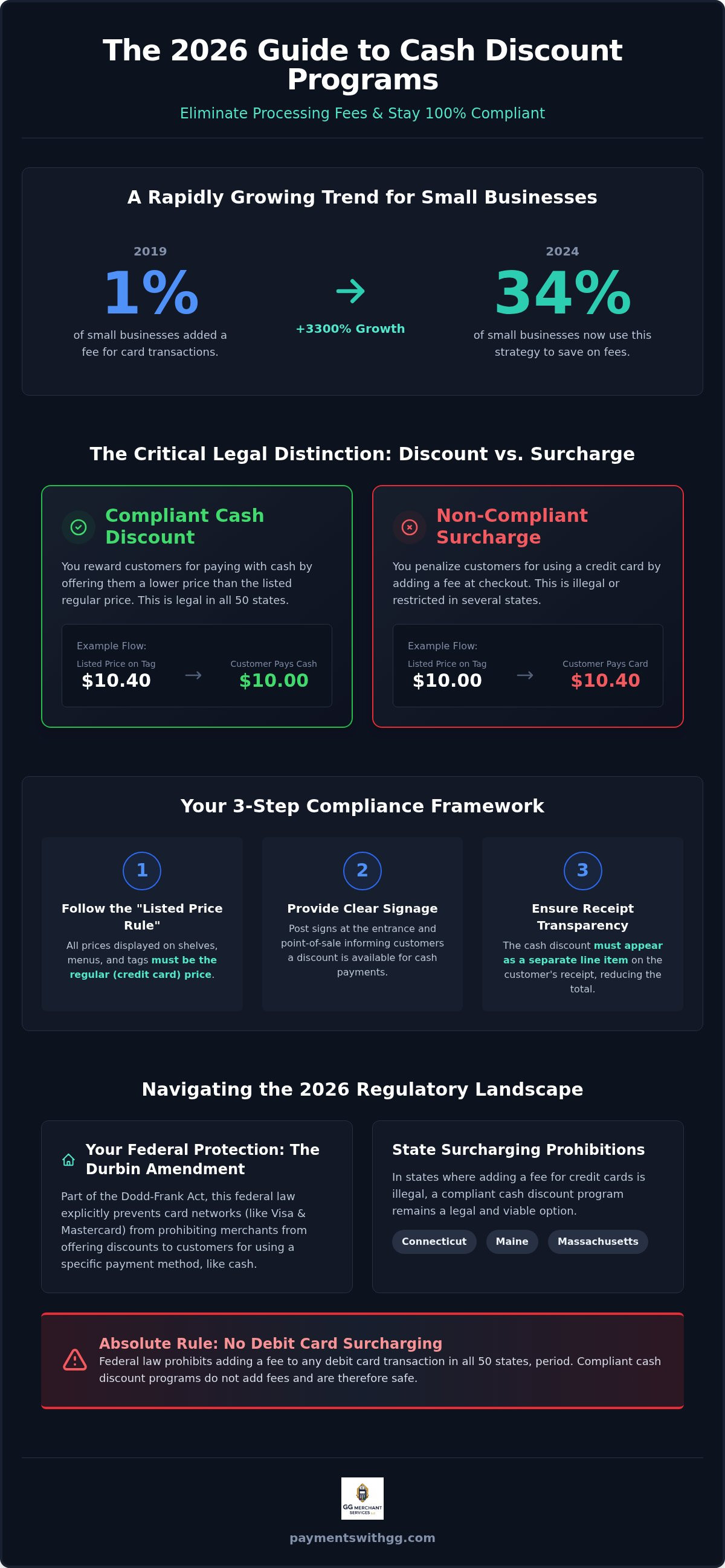
In 2019, only about 1% of small businesses added a fee to credit card transactions, but by 2024, that number climbed to 34%. As overhead costs rise and interchange fees reach record highs, you're likely feeling the pressure to protect your margins without alienating your loyal customers. Understanding the specific cash discount program legal requirements is no longer just a secondary task; it's a necessity for business survival in 2026. You want to eliminate those predatory processing fees, but the fear of a surprise audit or a heavy fine from Visa often keeps you stuck paying the bill yourself.
It's frustrating to deal with the confusing jargon of surcharges versus discounts, especially when your stability is on the line. We're here to act as your advocate and demystify the federal regulations and card brand rules that govern your merchant account. This guide provides the exact legal framework you need to reach 0% processing fees while staying 100% compliant. We'll walk through the current 2026 state bans, the "Listed Price" rule, and provide the exact signage and receipt templates required to keep your business safe and your customers informed.
Key Takeaways
- Learn how the Durbin Amendment provides the federal protection you need to meet cash discount program legal requirements in every state.
- Master the "Listed Price Rule" to clearly distinguish your program from restricted surcharging and keep your merchant account in good standing.
- Identify the exact signage and receipt disclosures required by card brands to ensure your business remains transparent and audit-ready.
- Navigate the 2026 regulatory landscape, including specific updates for states like Connecticut, Maine, and Massachusetts where surcharging is prohibited.
- Discover how to automate your compliance and eliminate manual errors by leveraging modern payment technology or solutions offered by GG Merchant Services LLC.
Understanding the Legality of Cash Discount Programs
Legality starts with a clear distinction between adding a fee and offering a discount. A true cash discount program involves a business displaying a "regular" price for all items, then offering a lower price to customers who pay with cash. This distinction is the core of Cash Discount vs. Surcharge legality. While surcharging adds a fee specifically for credit card users at the point of sale, a cash discount program rewards cash payers. This nuance is why meeting cash discount program legal requirements is possible in all 50 states, even where surcharging faces heavy restrictions.
The Durbin Amendment and Your Rights
The Durbin Amendment, part of the 2010 Dodd-Frank Wall Street Reform and Consumer Protection Act, serves as the federal shield for your business. It explicitly prevents card networks like Visa or Mastercard from stopping you from offering a discount to customers for using a specific payment method. In 2026, the Durbin Amendment continues to protect a merchant's right to offer incentives for cash payments, effectively capping the power of card brands to dictate your pricing strategies. While card brands can regulate how you implement these programs, they cannot ban the practice of discounting. This law provides the stability you need to manage your overhead without interference from large financial institutions.
Federal vs. State Authority
Federal law establishes your fundamental right to discount, but state consumer protection laws add another layer of complexity. Since the 2013 class-action settlement between merchants and card networks, the legal landscape has shifted toward greater merchant freedom. However, the "Right to Discount" remains more universally protected than the "Right to Surcharge." In states like Connecticut or Massachusetts, adding a credit card fee is restricted, but offering a discount for cash is still permitted because it doesn't penalize the consumer beyond the advertised price. Federal authority ensures the framework exists, while state laws focus on how you communicate that framework to your local customers.
To stay compliant, your shelf prices must be the "regular" or credit price. If a customer sees a $10 price tag and pays $10.40 at the register because they used a card, you've committed a surcharge violation. If they see $10.40 on the tag and pay $10 with cash, you've successfully implemented a compliant discount. Transparency is your best defense against audits. Card brands like Visa and Mastercard have strict participation rules that require you to notify them before starting a program, and they often perform spot checks to ensure your signage matches your software settings.
Cash Discount vs. Surcharge: The Legal Line You Can’t Cross
Many business owners fall into the "Surcharge Trap" without realizing it. They believe they are running a discount program while they are actually adding an illegal fee at the register. The core of cash discount program legal requirements rests on the "Listed Price Rule." This rule mandates that every price tag on your shelf must reflect the "Credit" or "Regular" price. If your customer sees a price on a shelf but pays a higher amount at the checkout because they used a card, you aren't discounting; you're surcharging. This distinction is vital because surcharging comes with a 3% cap and mandatory network notification requirements that don't apply to true discounting.
You should also be wary of "Non-Cash Adjustments" (NCA). Some processors use this term to suggest a fee is a neutral adjustment, but card brands view it differently. If your receipt shows an "NCA" added to the subtotal, you're at high risk for fines. Mislabeling a surcharge as an adjustment doesn't protect you; it actually flags your business for non-compliance during card brand audits. A true discount always moves the price downward from the listed amount, never upward.
Identifying a Compliant Program
A compliant program uses a "positive" price adjustment framework. This means the customer pays the price they saw on the shelf, or they pay less if they choose cash. If your processor labels a fee as a "Service Fee" but only applies it to card transactions, they're putting your merchant account at risk. These are often just surcharges in disguise. To protect your business, you can audit your current setup with a local partner to ensure your software is configured correctly for 2026 standards.
The Debit Card Restriction
Federal law is clear: you can never surcharge a debit card. This rule applies in all 50 states, regardless of local surcharging laws. Major networks view debit cards as cash equivalents, and surcharging them is a direct violation of the Durbin Amendment. In 2026, Visa's updated rules require merchants to provide absolute transparency, ensuring customers aren't charged credit-style fees when using debit. A true cash discount program handles this by keeping the price the same for all card types, including debit and prepaid. Only cash payers receive the lower price. Understanding the Legality of Cash Discount Programs ensures you provide a fair experience that keeps your business and your customers safe.
Strict Compliance Requirements for Signage and Receipts
Transparency is the most effective way to avoid merchant account freezes and customer disputes. To meet cash discount program legal requirements, your business must inform customers of your pricing structure long before they pull out their wallets. This disclosure happens in three distinct phases: at the door, at the register, and on the paper receipt. If any of these links in the chain are missing, card brands may categorize your program as an illegal surcharge, leading to heavy fines or termination of your processing privileges.
Signage Wording and Placement
Visa and Mastercard have updated their 2026 guidelines to ensure customers are never surprised by the final total. For Sacramento area retailers and restaurants, point-of-entry signage must be placed at every public entrance. This isn't just a best practice; it's a rule. The wording must be clear and conspicuous. A standard compliant phrase is: "All prices in this establishment reflect a cash discount. Customers who pay with cash will receive a discount from the regular price."
Common mistakes often occur at the point of sale. If you only have a sign at the door but nothing at the register, you're vulnerable during "Secret Shopper" audits. These auditors, hired by card networks, look for signs that are obscured by other marketing materials or placed too low for the average customer to see. Ensure your signage is at eye level and printed in a font size that's easily readable from three feet away. In local hubs like Folsom or Roseville, local inspectors also check for these disclosures to ensure consumer protection standards are met.
Receipt Itemization Standards
The receipt is the final piece of evidence in a compliance audit. It must clearly distinguish between the "Regular Price" and the "Cash Discount" applied to the transaction. You cannot simply show a final total and call it a day. The receipt must act as a line-item map of the transaction. This level of detail satisfies cash discount program legal requirements by proving that the customer paid the advertised price or less. If the receipt doesn't show the discount as a separate line item, it looks like a standard transaction, which can trigger red flags during a brand review.
Modern hardware like Clover POS Systems and Valor Paytech Terminals automate this process. These systems are designed to calculate the discount instantly and print a compliant receipt without manual input from your staff. They establish the "Regular Price" as the baseline, ensuring your accounting remains transparent. Staff training is also vital. Your team should be trained to explain the program simply: "Our prices are listed at the regular rate, but we offer a discount if you'd like to pay with cash today." This verbal disclosure reduces friction and prevents the consumer complaints that often trigger card brand investigations.
State-Specific Laws and Card Brand Regulation Updates
The legal landscape for merchant fees has shifted significantly following the major Visa-Mastercard settlement of June 2026. This settlement introduced temporary reductions in interchange rates and revised the "honor-all-cards" rule, giving you more flexibility in how you handle processing costs. However, geography still dictates your specific strategy. As of August 2026, credit card surcharges remain expressly prohibited in Connecticut, Maine, and Massachusetts. Despite these local bans on surcharging, a properly structured cash discount program is legal in all 50 states. This is because federal law protects your right to offer an incentive for cash payments, which is legally distinct from penalizing a cardholder. Meeting cash discount program legal requirements across different regions requires a nuanced approach to ensure your software settings match local statutes.
California Merchant Rights in 2026
California merchants in Sacramento and Folsom operate under some of the nation's most robust consumer protection laws. While California allows for price differentials between cash and credit, the state's Civil Code emphasizes that these differences must be disclosed clearly to avoid being labeled as "misleading." For local businesses in Davis and Woodland, this means your disclosure strategy must be airtight. You aren't just following card brand rules; you're adhering to state standards that prioritize the customer's right to know the final price before they reach the counter. We've seen that being a "straight shooter" about your fees doesn't just keep you compliant; it builds long-term loyalty in our local communities.
Dual Pricing: The Gold Standard of Compliance
As card brands tighten their oversight in 2026, dual pricing has emerged as the safest legal path for most retailers. Unlike traditional discounting where a single price is shown and a discount is applied later, dual pricing displays both the cash price and the credit price on every shelf tag or digital menu. This eliminates the "Surcharge vs. Discount" debate entirely because the customer sees both options simultaneously. To implement this, your POS hardware must be capable of tracking two separate price points for every SKU in your inventory. Hardware like Clover POS Systems and Valor Paytech terminals are specifically designed to automate these complex calculations, ensuring that your receipts and displays are always in sync with cash discount program legal requirements. If you're ready to modernize your checkout experience, you can consult with our local Sacramento team to find the right hardware for your business.
Handling multi-state operations adds another layer of complexity. If your business has locations in both California and a surcharge-restricted state like Maine, a unified cash discount strategy is often the most efficient choice. By using a consistent discount model across all locations, you avoid the risk of accidentally applying a surcharge where it's prohibited. This steady, deliberate approach to compliance protects your merchant account from the aggressive "Secret Shopper" audits that card networks have increased in 2026. Staying informed about these updates ensures your business remains resilient against rising interchange costs while maintaining the trust of your customers.
Implementing a Compliant Program with GG Merchant Services LLC
GG Merchant Services LLC approaches implementation by looking at your business through the lens of a protective ally. We begin by auditing your existing terminal settings and pricing structures to identify hidden vulnerabilities that might lead to a card brand audit. This process ensures your operation meets all cash discount program legal requirements before you process a single transaction under the new model. We don't just ship equipment; we build a compliant foundation that stands up to the rigorous scrutiny of Visa and Mastercard. Our goal is to demystify the technical side of the business so you can focus on your customers.
Hardware-Level Compliance
Valor Paytech terminals are a cornerstone of our technology stack because they embed compliance logic directly into the transaction flow. These units automatically identify card types at the point of sale. This prevents you from accidentally applying discount logic to a debit card, which is a common source of compliance failures. Clover POS systems offer a different advantage for high-volume Sacramento retailers. We configure Clover to handle dual pricing flawlessly, printing receipts that clearly itemize the regular price and the cash savings. For businesses that require a more traditional terminal, Dejavoo POS units are programmed to manage adjustment logic safely. This ensures your accounting remains clean and your transactions are correctly labeled.
The GG Merchant Services LLC Advantage
The GG Merchant Services LLC advantage is built on transparency and local accountability. We take a straight shooter approach to our contracts, eliminating the convoluted language and hidden service fees that plague the industry. By combining a compliant program with Next Day Funding, we help you solve the dual challenge of rising costs and slow cash flow. You get the benefit of zero processing fees without waiting days for your money to hit your bank account. Our team provides hands-on setup and staff training for merchants in Sacramento, Folsom, and Roseville. Contact GG Merchant Services LLC for a local compliance check to verify your business is ready for the 2026 regulatory environment. We're here to provide the stability and reliability you need to thrive.
Securing Your Business for a Fee-Free Future
Reclaiming your profit margins doesn't have to be a source of stress or legal uncertainty. By prioritizing the "Listed Price Rule" and using automated hardware to handle complex calculations, you can satisfy every facet of the cash discount program legal requirements. The transition to a zero-fee model is a strategic move that protects your business from rising interchange costs while keeping your customer relationships transparent and fair. You've seen the rules and the technology; now it's about having a local partner to ensure the execution is flawless.
GG Merchant Services LLC stands ready to act as your protective ally in this evolving landscape. As a registered Paybotx partner, we provide the stability of a national network with the personalized, hands-on support only a local Sacramento, Folsom, or Roseville expert can offer. With Next Day Funding and 100% compliant hardware, we help you modernize your checkout experience without the risk of card brand penalties. Don't let confusing regulations hold your business back from reaching its full potential. Get a Free Compliance Audit for Your Sacramento Business from GG Merchant Services LLC and start your journey toward a more profitable future today.
Frequently Asked Questions
Is a cash discount program the same as surcharging?
No, they are legally distinct. Surcharging adds a fee to the listed price for credit users, which is capped at 3% by Visa. A cash discount offers a reduction from the regular listed price for cash users. This distinction is the core of cash discount program legal requirements. While surcharges are restricted in several states, true discounts are permitted nationwide because they provide a clear benefit to the consumer.
Are cash discount programs legal in California in 2026?
Yes, cash discount programs are legal in California. While California law requires clear disclosure of price differences, it doesn't prohibit rewarding cash payers. Merchants in Sacramento and Folsom must ensure their shelf prices reflect the regular credit price to remain compliant. This avoids the legal pitfalls associated with hidden fees and keeps your business aligned with state consumer protection standards and modern card brand rules.
Do I need to notify Visa or Mastercard before starting a program?
You must notify your acquirer or processor at least 30 days before starting a surcharge program, but true cash discount programs don't typically require this formal network notification. However, card brands still expect you to follow strict disclosure rules. Working with a local registered partner ensures your program is correctly categorized so you don't face unexpected audits or fines for mislabeling your fee structure or hardware settings.
Can I apply a cash discount to debit card transactions?
You cannot apply a cash discount to a debit card payment; only physical cash or check qualifies for the lower price. Federal law treats debit cards as cash equivalents, and surcharging them is strictly prohibited in all 50 states. A compliant program ensures that debit card users pay the same "regular" price as credit card users. This prevents the legal risks associated with misidentifying card types at the register.
What happens if a customer complains about the program to the Attorney General?
If a complaint is filed, the Attorney General's office will typically investigate your signage and receipt transparency. If you have followed all cash discount program legal requirements, including clear point-of-entry and point-of-sale disclosures, you're well protected. We help our local partners maintain an audit trail of compliant signage and software settings to resolve these disputes quickly and maintain their business reputation without facing legal penalties.
What specific signs am I required to display in my store?
You must display clear, conspicuous signage at every public entrance and at every point of sale terminal. These signs must explicitly state that all listed prices reflect a cash discount and that customers paying with cash receive a lower price. The font must be easily readable from a distance of three feet. Proper placement ensures that every customer is fully informed of their payment options before they reach the checkout counter.
Can I use a cash discount program for an online e-commerce store?
Yes, you can implement these programs online, but the technical execution is different. Your digital checkout must clearly show the regular price and then apply a cash discount if a qualifying payment method is selected. Most e-commerce platforms require specific plugins to handle this logic accurately. It's vital that the final total never exceeds the price displayed on the initial product page to avoid being flagged for an illegal surcharge.
How does dual pricing differ from a cash discount program?
Dual pricing shows two distinct prices, cash and credit, for every item, while a cash discount program usually shows one price and applies a discount at the register. Dual pricing is often considered the gold standard for compliance because it removes any ambiguity for the customer. It requires POS hardware like Clover or Valor that can manage two price points for every SKU in your inventory while keeping your receipts itemized.
Frequently Asked Questions
No, they are legally distinct. Surcharging adds a fee to the listed price for credit users, which is capped at 3% by Visa. A cash discount offers a reduction from the regular listed price for cash users. This distinction is the core of cash discount program legal requirements. While surcharges are restricted in several states, true discounts are permitted nationwide because they provide a clear benefit to the consumer.
Yes, cash discount programs are legal in California. While California law requires clear disclosure of price differences, it doesn't prohibit rewarding cash payers. Merchants in Sacramento and Folsom must ensure their shelf prices reflect the regular credit price to remain compliant. This avoids the legal pitfalls associated with hidden fees and keeps your business aligned with state consumer protection standards and modern card brand rules.
You must notify your acquirer or processor at least 30 days before starting a surcharge program, but true cash discount programs don't typically require this formal network notification. However, card brands still expect you to follow strict disclosure rules. Working with a local registered partner ensures your program is correctly categorized so you don't face unexpected audits or fines for mislabeling your fee structure or hardware settings.
You cannot apply a cash discount to a debit card payment; only physical cash or check qualifies for the lower price. Federal law treats debit cards as cash equivalents, and surcharging them is strictly prohibited in all 50 states. A compliant program ensures that debit card users pay the same "regular" price as credit card users. This prevents the legal risks associated with misidentifying card types at the register.
If a complaint is filed, the Attorney General's office will typically investigate your signage and receipt transparency. If you have followed all cash discount program legal requirements, including clear point-of-entry and point-of-sale disclosures, you're well protected. We help our local partners maintain an audit trail of compliant signage and software settings to resolve these disputes quickly and maintain their business reputation without facing legal penalties.
You must display clear, conspicuous signage at every public entrance and at every point of sale terminal. These signs must explicitly state that all listed prices reflect a cash discount and that customers paying with cash receive a lower price. The font must be easily readable from a distance of three feet. Proper placement ensures that every customer is fully informed of their payment options before they reach the checkout counter.
Yes, you can implement these programs online, but the technical execution is different. Your digital checkout must clearly show the regular price and then apply a cash discount if a qualifying payment method is selected. Most e-commerce platforms require specific plugins to handle this logic accurately. It's vital that the final total never exceeds the price displayed on the initial product page to avoid being flagged for an illegal surcharge.
Dual pricing shows two distinct prices, cash and credit, for every item, while a cash discount program usually shows one price and applies a discount at the register. Dual pricing is often considered the gold standard for compliance because it removes any ambiguity for the customer. It requires POS hardware like Clover or Valor that can manage two price points for every SKU in your inventory while keeping your receipts itemized.
Related articles