
Cash Discount Signage: 2026 Merchant Compliance Guide
August 15, 2026 · 17 min read
What if the only thing standing between your business and a zero-fee processing model wasn't a complex legal hurdle, but a simple piece of plastic on your front door? Most merchants feel a sense of dread when they think about changing their pricing structure, fearing that a hidden card brand rule or a confused customer might derail their operations. You've likely heard the horror stories of hefty fines or lost loyalty, and it's natural to feel anxious about getting your cash discount signage exactly right.
We know that the distinction between surcharging and cash discounting feels like a legal tightrope, especially with the 2026 Visa-Mastercard settlement introducing new shifts to the industry landscape. This guide will help you master the specific legal requirements and strategic placement of your disclosures so you can eliminate credit card fees with total confidence. We'll walk through the exact language your signs must display and how modern hardware from Clover or Valor can automate your compliance. You'll finish this guide with a clear roadmap for a professional, 100% compliant storefront that protects your bottom line while maintaining customer trust.
Key Takeaways
- Understand how the Durbin Amendment protects your right to offer incentives for cash payments while maintaining full legal compliance.
- Learn the specific 2026 card brand requirements for cash discount signage to ensure your disclosures meet the latest Visa and Mastercard visibility standards.
- Master the "Point of Entry" and "Point of Sale" rules to properly notify customers before they shop and again before they pay.
- Discover how Clover and Valor POS systems automate receipt disclosures, removing the manual stress of transaction-level compliance.
- Use proven wording templates that frame your pricing as a benefit to the customer, reducing friction and preserving brand loyalty.
Why Proper Cash Discount Signage is a Non-Negotiable for Merchants
Implementing a zero-fee model is one of the most effective ways to protect your margins, but it requires more than just a software update on your terminal. Proper cash discount signage serves as the legal foundation for your entire program. It's the primary tool that ensures you stay compliant with the Durbin Amendment to the Dodd-Frank Act, which protects a merchant's right to offer incentives for different payment methods. Without clear, physical disclosures, your program could be viewed as an undisclosed fee rather than a legal discount.
Failure to display these notices carries significant risks. Card brands like Visa and Mastercard regularly conduct "secret shopper" audits to verify that merchants are following disclosure rules. If your signage is missing or worded incorrectly, you may face immediate fines from the card networks. In severe cases of repeated non-compliance, processors may even terminate your merchant account, which can halt your ability to accept payments entirely. Beyond the legal risks, clear signage provides a psychological safety net. It sets customer expectations the moment they walk in, preventing the "sticker shock" that leads to complaints and negative reviews.
Cash Discounting vs. Surcharging: The Signage Distinction
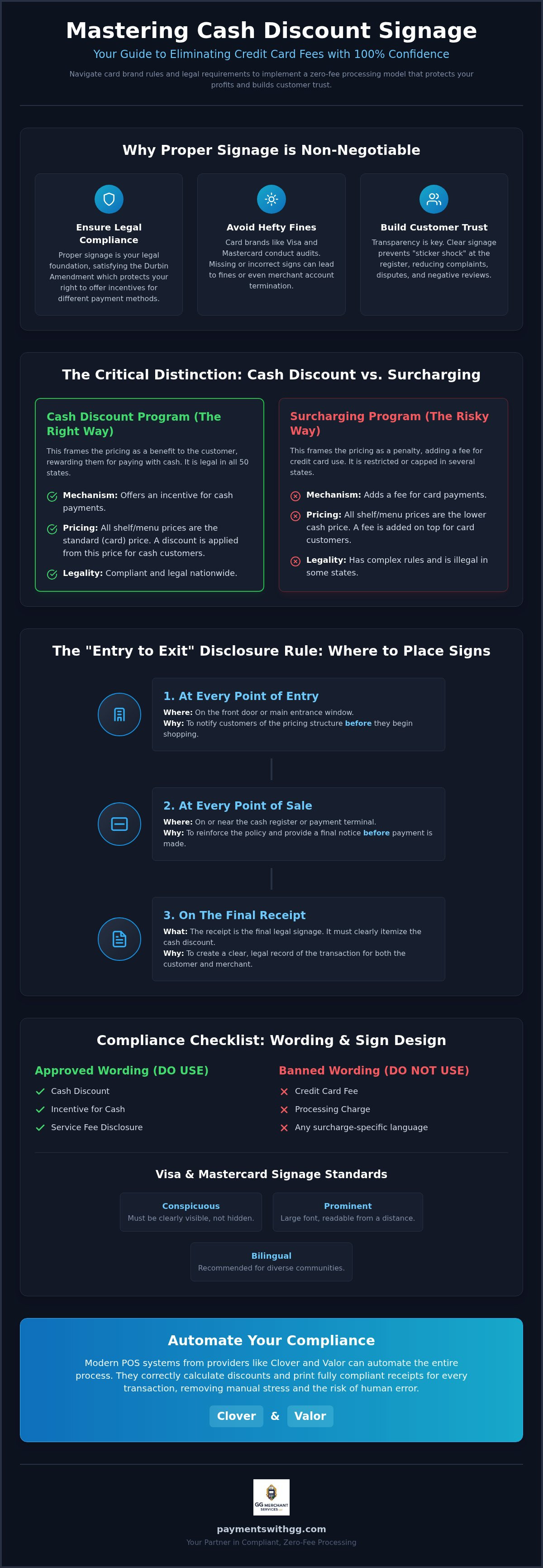
It's vital to understand that a cash discount and a Surcharge (payment systems) are handled very differently under the law. Surcharging involves adding a fee to a listed price, which is still restricted or capped in certain states. In contrast, a true cash discount program offers a lower price for cash customers compared to a standard "service" price. You cannot use surcharge-specific language on your signs if you are running a cash discount program. As of 2026, cash discounting remains legal in all 50 states because it is framed as an incentive for the consumer rather than a penalty for using a card.
The Role of Transparency in Consumer Protection
Transparency is your best defense against claims of deceptive trade practices. To remain compliant, you must follow the "Entry to Exit" disclosure rule. This means placing cash discount signage at every point of entry and every point of sale. If a customer only learns about the pricing difference when they see the receipt, they may feel misled. Clear signage acts as your first line of defense in a payment dispute or chargeback, proving that the customer was fully informed of the pricing structure before they made a purchase decision. This level of clarity builds long-term trust with your local community.
Card Brand Requirements: What Visa and Mastercard Demand
Visa's 2026 Global Core Rules are very specific about how you communicate pricing to your customers. Your cash discount signage must be conspicuous, meaning it shouldn't be hidden behind a monitor or buried under other promotional posters. Mastercard follows a similar "clear and prominent" standard. For high-traffic retail stores, this means using a font size that's large enough to read from a distance of several feet. In regions like Sacramento, where the market is culturally diverse, it's highly recommended to provide bilingual signage. This ensures all customers, regardless of their primary language, are fully aware of the incentive for paying with cash.
While merchants often check state-by-state surcharge laws to understand local limits, card brand rules are a separate layer of compliance that applies regardless of your zip code. Staying ahead of these requirements protects your merchant account from unexpected audits and ensures your business maintains a professional reputation.
Specific Wording That Keeps You Safe
The words you choose for your displays can make or break your compliance status. Approved phrases include "Cash Discount," "Incentive for Cash," or "Service Fee Disclosure." You must avoid banned phrases like "Credit Card Fee" or "Processing Charge" on your primary cash discount signage. These terms suggest you're penalizing the cardholder, which is the hallmark of a surcharge program rather than a discount program. Another critical factor is the "Listed Price" rule. The price on your menus or shelf tags should represent the standard price. When a customer pays with cash, they receive a discount from that listed amount. This distinction is vital for maintaining transparency and following current industry standards.
The Receipt Requirement: The 'Hidden' Signage
Compliance doesn't stop at the window or the counter. The printed receipt is legally considered a final form of signage. It must itemize the transaction clearly, showing the standard service price and the specific discount applied for the cash payment. This documentation is your best proof of compliance if a customer ever disputes a charge. Managing these line items manually is difficult and prone to error. This is why many local businesses use Clover POS systems or Valor Paytech terminals. These systems are designed to automate the math and print the necessary disclosures on every receipt. This automation removes the burden from your staff and ensures every sale meets the strict criteria set by Visa and Mastercard.
Strategic Placement: Where to Display Your Notices
Success with a zero-fee model depends on visibility throughout the customer journey. If a shopper feels surprised at the register, you risk losing their trust. To prevent this, you must follow the "Point of Entry" rule. This requires your cash discount signage to be visible before a customer begins their experience. Whether it's a window decal or a sign at the hostess stand, the goal is to set the price expectation early. This isn't just a best practice; it's a core component of staying compliant with card brand expectations.
The second critical location is the "Point of Sale." This serves as the final disclosure before a transaction is finalized. Modern systems like Clover POS Systems make this seamless by using customer-facing screens to display digital disclosures. This digital approach ensures the message is seen exactly when the customer is ready to pay, fulfilling the transparency requirements outlined in Visa's official rules. By combining physical and digital notices, you create a layered defense against compliance audits.
Retail and Restaurant Specific Layouts
In a restaurant setting, a single sign at the entrance might not be enough to satisfy every auditor. Hostess stands are ideal for initial notice, but individual table tents can reinforce the message during the dining experience. For drive-thru operations, placement is even more sensitive. You should place the notice near the menu board so the customer sees it before they place their order. Window decals are effective but should be placed at eye level on the main entrance door to balance professional aesthetics with legal necessity. This ensures the information is accessible without cluttering your storefront.
Mobile and Field Service Signage
Mobile merchants face unique challenges because their "storefront" is often a vehicle or a handheld device. If you are a Sacramento HVAC technician or plumber, your cash discount signage might be a physical card attached to your clipboard or a clear disclosure on your tablet before the customer signs for the work. For those using Dejavoo mobile terminals or Valor Paytech Terminals, the device itself can often handle digital disclosures on the screen. This provides a compliant checkout experience even when you are working on-site at a client's home.
- Truck-side decals for service vehicles ensure visibility as soon as you arrive.
- Terminal-based disclosures provide a final check before the card is swiped.
- Mobile payment apps must include a clear line item for both the service fee and the subsequent cash discount.
Wording Your Notice: Psychology and Compliance Templates
The way you phrase your pricing determines whether a customer feels valued or frustrated. Using a "Benefit Framing" technique allows you to present your pricing structure as a reward for cash users rather than a burden for card users. This subtle shift in communication is why cash discount signage is such a powerful tool for maintaining customer loyalty. When your messaging focuses on the savings, it reinforces your brand as a fair, transparent local partner. It's about showing the customer how they can save money, which feels much better than telling them why they are paying more.
Template 1: The Standard Cash Discount Notice
For a program with a 3.5% or 4% adjustment, the wording must be exact to satisfy card brand auditors. A safe, compliant template should read: "To encourage cash payments, we provide a [Percentage]% discount to customers who pay with cash. The prices shown on our menu reflect the standard service price." You should always insert your specific business name and the exact discount percentage you've chosen. To ensure the sign is conspicuous, use a bold, sans-serif font with high contrast, such as black text on a bright white background. Avoid using red text for the discount amount, as this can psychologically trigger a sense of "warning" or "penalty" for the customer.
Template 2: The Dual Pricing Disclosure
Dual pricing is often considered the most transparent model because it removes the need for customers to do mental math. By displaying a "Cash Price" and a "Card Price" side-by-side, you provide total clarity at the moment of decision. This method is highly effective for retail environments with many individual shelf tags. Clover POS Systems simplify this process by automating the dual-price labels; this ensures your physical signs always match what the customer sees on the screen. This consistency is a major factor in passing card brand audits and reducing friction at the register.
Employee Scripts: Backing Up the Signage
Your staff is your second line of defense after your physical signs. If a customer asks why their receipt shows a service fee, your team should be trained to point to the cash discount signage as the definitive source of truth. This prevents inconsistent answers that could lead to disputes or complaints. A great sentence for your cashiers to memorize is: "We offer a discount for cash payments to help keep our local prices as low as possible for everyone." This framing positions the business as an ally to the community, making the policy feel like a shared effort to save money.
If you're ready to modernize your storefront with the right tools, you can get professional signage and compliant POS hardware from GG Merchant Services LLC today.
Compliant Solutions with GG Merchant Services LLC
GG Merchant Services LLC understands that local business owners have enough on their plates without worrying about the nuances of card brand audits. We act as your protective ally by providing the physical cash discount signage you need to stay compliant from the moment you open your doors. For new merchants in the Sacramento area, we provide these essential materials as part of your hardware setup. This ensures your storefront looks professional and meets every regulatory standard without you having to source your own displays or guess at the correct wording.
Our partnership with industry leaders like Valor Paytech and Dejavoo allows us to offer hardware that treats compliance as a built-in feature. These terminals are the gold standard for modern businesses because they handle the technical complexity of discounting for you. When you combine this automated technology with our Next Day Funding, your business enjoys a streamlined cash flow that matches the speed of your zero-fee model. GG Merchant Services LLC is here to demystify the process and provide a stable, reliable foundation for your financial growth.
Automated Compliance with Clover and Valor
Software is the heart of a successful discount program. Clover POS Systems and Valor terminals use software-driven disclosures that update automatically if card brands refresh their rules. This means your customer-facing displays will always satisfy the "Point of Sale" requirement digitally. We also help you customize receipt footers to meet specific local expectations in communities like Davis, Roseville, and Folsom. This level of detail ensures your business remains transparent and builds long-term trust with your neighbors. By automating the disclosures, GG Merchant Services LLC removes the risk of human error at the register.
Get Started: Compliant Cash Discounting in Sacramento
Transitioning to a new pricing model shouldn't feel like a high-pressure decision. We've developed a methodical 5-step setup process designed to move you from identifying operational pain points to discovering streamlined savings. If you're an existing business owner in the Sacramento region, GG Merchant Services LLC offers a free signage audit to ensure your current displays aren't leaving you vulnerable to network fines. We'll review your wording, placement, and terminal settings to give you total peace of mind. Our goal is to be more than just a processor; we want to be a knowledgeable consultant invested in your success.
Ready to eliminate fees without the compliance headache? Schedule your free compliance and savings analysis with GG Merchant Services LLC to see how our tailored solutions can protect your bottom line.
Take the Next Step Toward Zero-Fee Processing
Operating a successful business in 2026 requires a balance of modern technology and clear communication. You've learned that effective cash discount signage isn't just about sticking a decal on your window; it's a strategic tool for transparency and card brand compliance. By placing notices at every point of entry and utilizing automated systems like Clover or Valor, you protect your merchant account while providing a fair experience for your customers. This transition is about demystifying your pricing and building long-term trust with your community.
Transitioning to this model doesn't have to be a solo journey. GG Merchant Services LLC is here as your local partner in Roseville, Elk Grove, and Folsom to ensure your setup is flawless. We provide qualifying merchants with free Clover or Valor hardware that handles disclosures automatically. Plus, our Next Day Funding ensures your cash flow remains as fast as your sales. You've worked hard to build your business. Let's work together to keep more of your revenue where it belongs.
Get Your Compliant Cash Discount Signage and Hardware Today from GG Merchant Services LLC
Frequently Asked Questions
Is cash discount signage required by law in California?
Yes, clear transparency is required under California consumer protection standards. While state law explicitly allows for cash discounts, failing to provide proper notice can lead to claims of deceptive trade practices. You must ensure that every customer is fully informed of the pricing structure before they reach the register. This alignment with both state regulations and card brand rules is essential for maintaining a 100% compliant business operation in the Sacramento region.
Can I just write my own cash discount sign on a piece of paper?
You should avoid using handwritten notices for your business. Card brands like Visa require disclosures to be "conspicuous" and "clear," and a handwritten note often fails the professional appearance test. It also risks omitting specific legal language required for a compliant setup. Using standardized, high-contrast cash discount signage provided by a professional partner ensures you meet all 2026 visibility standards and protects you during a potential merchant audit.
What is the minimum font size for a cash discount notice?
Card brands don't mandate a universal point size, but they require that the notice be prominent and easily readable. In a typical retail environment, this means using a font size of at least 14 to 16 points for counter displays and much larger for entrance decals. The goal is for a customer with average vision to read the notice from several feet away without difficulty. This prevents any claims that the disclosure was hidden or obscured.
Do I need a sign if I use a dual-pricing model?
Yes, you still need a general disclosure sign even when using a dual-pricing model. While showing two prices on every item provides excellent transparency, card brands still require a master notice at the entrance and point of sale. This notice explains the relationship between the two prices and confirms that the lower price is an incentive for cash. It acts as a legal safety net and reinforces the transparency of your entire pricing structure.
Where is the best place to put a cash discount sticker in a restaurant?
In a restaurant, visibility must start at the front door and end at the payment terminal. You should place your primary cash discount signage on the main entrance door at eye level. Additionally, include a notice at the hostess stand or on the front of the menu. If customers pay at the table, using a small table tent or a digital disclosure on a handheld terminal ensures they are informed before the bill ever arrives.
What happens if a customer complains to Visa about my signage?
Visa may initiate a merchant audit if they receive a complaint regarding improper disclosures. This often involves a secret shopper visit to verify your signage placement and wording. If your business is found non-compliant, you could face immediate fines or be required to overhaul your program within a strict timeframe. Having professional signage and automated receipt disclosures from Clover or Valor is your best defense against these potentially costly and stressful brand audits.
Does Clover POS automatically show the cash discount on the screen?
Yes, Clover POS systems are designed to satisfy digital disclosure requirements automatically. When the cash discount app is properly configured, the customer-facing screen displays the standard price and the cash discount amount before the customer swipes their card. This real-time transparency satisfies the Point of Sale rule and reduces the likelihood of customer confusion. It ensures that the final stage of the checkout process is as clear and professional as possible.
Can I use the same sign for both debit and credit card transactions?
You must be careful with how you treat debit cards in your messaging. Card brand rules strictly prohibit surcharging debit cards, even when they are processed as credit. However, a true cash discount program applies to anyone not paying with cash. Your signage should clearly state that the discount is for cash payments only. This distinction ensures you don't accidentally violate the Durbin Amendment or card network rules regarding debit card transaction processing.
Frequently Asked Questions
Yes, clear transparency is required under California consumer protection standards. While state law explicitly allows for cash discounts, failing to provide proper notice can lead to claims of deceptive trade practices. You must ensure that every customer is fully informed of the pricing structure before they reach the register. This alignment with both state regulations and card brand rules is essential for maintaining a 100% compliant business operation in the Sacramento region.
You should avoid using handwritten notices for your business. Card brands like Visa require disclosures to be "conspicuous" and "clear," and a handwritten note often fails the professional appearance test. It also risks omitting specific legal language required for a compliant setup. Using standardized, high-contrast cash discount signage provided by a professional partner ensures you meet all 2026 visibility standards and protects you during a potential merchant audit.
Card brands don't mandate a universal point size, but they require that the notice be prominent and easily readable. In a typical retail environment, this means using a font size of at least 14 to 16 points for counter displays and much larger for entrance decals. The goal is for a customer with average vision to read the notice from several feet away without difficulty. This prevents any claims that the disclosure was hidden or obscured.
Yes, you still need a general disclosure sign even when using a dual-pricing model. While showing two prices on every item provides excellent transparency, card brands still require a master notice at the entrance and point of sale. This notice explains the relationship between the two prices and confirms that the lower price is an incentive for cash. It acts as a legal safety net and reinforces the transparency of your entire pricing structure.
In a restaurant, visibility must start at the front door and end at the payment terminal. You should place your primary cash discount signage on the main entrance door at eye level. Additionally, include a notice at the hostess stand or on the front of the menu. If customers pay at the table, using a small table tent or a digital disclosure on a handheld terminal ensures they are informed before the bill ever arrives.
Visa may initiate a merchant audit if they receive a complaint regarding improper disclosures. This often involves a secret shopper visit to verify your signage placement and wording. If your business is found non-compliant, you could face immediate fines or be required to overhaul your program within a strict timeframe. Having professional signage and automated receipt disclosures from Clover or Valor is your best defense against these potentially costly and stressful brand audits.
Yes, Clover POS systems are designed to satisfy digital disclosure requirements automatically. When the cash discount app is properly configured, the customer-facing screen displays the standard price and the cash discount amount before the customer swipes their card. This real-time transparency satisfies the Point of Sale rule and reduces the likelihood of customer confusion. It ensures that the final stage of the checkout process is as clear and professional as possible.
You must be careful with how you treat debit cards in your messaging. Card brand rules strictly prohibit surcharging debit cards, even when they are processed as credit. However, a true cash discount program applies to anyone not paying with cash. Your signage should clearly state that the discount is for cash payments only. This distinction ensures you don't accidentally violate the Durbin Amendment or card network rules regarding debit card transaction processing.